
The elderly health program in Thailand was initiated under the royal initiative of His Majesty King Bhumibol Adulyadej the Great. The country’s first Senior Citizens’ Club was established on 6 December 1962. At that time, Professor Dr. Prasop Rattanakorn who served as the Director of the Neurological Hospital, further advanced elderly care by founding Thailand’s first geriatric clinic at his hospital in March 1963.
During the administration of Prime Minister General Prem Tinsulanonda, the Thai government enacted a comprehensive public health policy consisting of 66 directives. Among these, Directive No. 1 was particularly significant for elderly healthcare. It emphasized the urgent expansion of the Primary Health Care Program to underserved villages and sub-districts, aiming to improve access to disease prevention, health promotion, and basic medical services. The directive also called for medical assistance for low-income individuals and the elderly, and encouraging collaboration with the private sector to enhance service delivery. Between 1980 and 1981, the Ministry of Public Health appointed a working group and a committee to promote the health of the elderly. These bodies undertook a range of initiatives, including: training programs for physicians, nurses, and social workers; academic conferences; support for the establishment of geriatric clinics and elderly clubs in hospitals nationwide; provision of health services for older adults; public education campaigns; and the initiation of research related to aging and elderly care.
The Department of Medical Services, a technical agency under the Ministry of Public Health, has consistently played a pivotal role in elderly care. On 5–6 November 1982, in collaboration with the World Health Organization, the department organized the 6th National Seminar on Health Services for the Elderly at the Indra Regent Hotel in Bangkok. The seminar yielded valuable insights into the status and challenges faced by the elderly population in Thailand, as well as the provision of geriatric health services both domestically and internationally.
On 6 February 1982, the Cabinet passed a resolution to establish the National Elderly Commission, chaired by the Minister of Interior. The commission comprised 25 members, including representatives from relevant government agencies, distinguished experts, and private sector organizations. Within this commission, the Director-General of the Department of Medical Services, Ministry of Public Health, was appointed to chair two subcommittees: (1) the Subcommittee on Research and Long-Term Planning for the Elderly, and (2) the Subcommittee on Coordination of Health Services for the Elderly.
From 26 July to 5 August 1982, the United Nations convened the World Assembly on Aging in Vienna, Austria, focusing on academic discourse and the drafting of the International Plan of Action on Aging. Delegates from 119 countries participated in the assembly. Representing Thailand, the Minister of Interior served as the head of the delegation, with the Deputy Director-General of the Department of Medical Services attending as the official representative. The outcome of the assembly included a call for all member states to formulate policies and develop national action plans to address the needs of the aging population.
In October 1982, an academic seminar was held at the Priest Hospital’s conference hall on the topic of “The Role of Various Organizations in Long-Term Planning for the Elderly.” The resolutions from this seminar served as the foundation for the development of Thailand’s Long-Term National Plan for the Elderly (1982–2002). This master plan provided strategic guidance for the formulation of action plans across five key areas:
On 27 August 1986, Prime Minister General Prem Tinsulanonda announced a set of 32 public health policies, Policy No. 2 of which contributed to elderly health services. It called for “Support the provision of basic public health services to the population, carried out earnestly and continuously by both government and private organizations. In cases where services are provided by the government, they shall be offered free of charge to the elderly, children, and low-income individuals.” In alignment with this policy, the Fifth Public Health Development Plan (1987–1991) tasked the Department of Medical Services with expanding primary health care outreach to all communities, promoting public understanding of behaviors that contribute to non-communicable diseases. These objectives were incorporated into the Sixth Public Health Development Plan, which outlined 15 specific projects—one of which focused on elderly care.
Following this policy and the 2nd National Seminar on Health Services for the Elderly, held at the Royal River Hotel in Bangkok on 25–26 April 1990, several strategic approaches to elderly health services were proposed. These included: free medical treatment for older adults, the issuance of elderly identification cards, income tax reductions for caregivers of the elderly, and the establishment of a dedicated agency responsible for elderly affairs. At that time, under the leadership of Dr. Vitoon Saengsingkaew, Deputy Director-General, and Dr. Sujin Palakornkul, Director-General of the Department of Medical Services, a proposal was made to form a working group for the establishment of an institute dedicated to elderly care. This initiative was formalized under Order No. 89/1990, dated 6 June 1990, with Dr. Anan Sukonthanaram Na Phatthalung, Chief Medical Officer of the Department, appointed as chair of the working group. The working group reached a key resolution to name the that institute the “National Institute for Health and Geriatric Medicine Development,” a division under the Department of Medical Services.
The “National Institute for Health and Geriatric Medicine Development” was expected to address the following objectives:
General Objective – To serve as a national institute and center for the advancement of academic knowledge in geriatric medicine, and to lead the coordination of elderly health services across the country to ensure Thai older adults’ good health and longevity.
Specific Objectives – To act as a core institution for research in geriatric medicine and epidemiology to develop effective models for medical and public health services for the elderly; to provide training for medical and public health personnel involved in elderly care; to function as an information and technology dissemination center; and to facilitate patient referral systems with public hospitals by establishing minimum service standards for elderly healthcare at various levels.
In 1991, Thailand began allocating budgetary resources specifically for medical and public health services for the elderly. This particular year also marked the initiation of elderly identification cards, the establishment of geriatric clinics, and the formation of elderly clubs nationwide.
During the Second Public Health Development Plan (1992–1996), the Department of Medical Services underwent organizational restructuring on 29 October 1992, leading to the formal establishment of the Institute for Health and Geriatric Medicine Development as an internal division. This institute was designated as the central body for advancing academic knowledge in geriatric medicine and coordinating elderly health services across the country. The government also issued a clear policy to provide medical assistance to the elderly through a nationwide welfare card system, ensuring equitable access to healthcare. Subsequently, the First National Seminar on Coordinating Elderly Health Service Plans was held at the Queen Sirikit National Convention Center on 26-27 April 1993. The seminar resulted in resolutions and recommendations to promote the establishment of elderly clubs, the nationwide use of elderly ID cards, and the creation of a dedicated agency for elderly affairs. This agency would focus on academic research, information dissemination, public awareness, and the development of specialized personnel in geriatric care.
In 1991, the Elderly Health Promotion Center was established at Wat Yannasangwararam in Chonburi Province. His Holiness Somdet Phra Nyanasamvara, the 19th Supreme Patriarch of Thailand, graciously accepted the role of patron. The center was founded in honor of Her Majesty the Queen on the occasion of her 50th birthday, celebrated on August 12, 1992. Its primary objectives were to promote health, prevent and provide primary treatment for illnesses, and support rehabilitation for the elderly, alongside advancing academic and medical development in the field of geriatric care.
In 1994, a Royal Decree was issued to restructure the Department of Medical Services under the Ministry of Public Health, leading to the establishment of the “Institute of Geriatric Medicine” as a division-level agency. This institute was responsible for overseeing elderly care, with the aim of enhancing the quality of life, longevity, and overall well-being of older adults. The decree was published in the Royal Gazette, Volume 111, Section 21 Kor, pages 7–16, dated 3 June 1994. Subsequently, the institute was designated as the central coordinating body for related agencies in the development of the National Elderly Act, B.E. 2546 (2003), which was published in the Royal Gazette, Legislative Edition, Volume 120, Section 130 Kor, dated 31 December 2003. The law came into effect on 1 January 2004. The institute also played a key role in formulating the Second National Plan for the Elderly (2002–2021).
In 2009, Thailand commemorated the auspicious occasion of His Majesty King Bhumibol Adulyadej the Great reaching the age of 72, coinciding with the United Nations’ declaration of the International Year of Older Persons. This prompted heightened awareness among the government, private sector, and social institutions regarding the importance of elderly well-being. The Institute of Geriatric Medicine was appointed as the central coordinating body to work with relevant agencies in establishing the Thai Elderly Declaration—a formal commitment to enhancing the quality of life for older adults. On 25 March 2003, Prime Minister Chuan Leekpai, along with representatives from nine political parties, signed the Thai Elderly Declaration. In alignment with the UN’s call to action, the Department of Medical Services collaborated with its affiliated agencies to launch elderly health initiatives as part of the International Year of Older Persons. These efforts also honored the royal milestone of His Majesty the King’s sixth cycle birthday (72 years) and the centenary of Her Royal Highness Princess Srinagarindra, the Princess Mother. A commemorative project was implemented to train public health personnel in elderly health screening and to provide proactive medical services, including eye, ear, and dental check-ups, as well as rehabilitation for disabilities. On 28 December 2009, the “Institute of Geriatric Medicine” was officially renamed to the “Somdet Phra Sangharaja Nyanasamvara Institute for the Elderly” in tribute to His Holiness the Supreme Patriarch.
In 2012, Dr. Wilawan Juengprasert, Director-General of the Department of Medical Services, initiated a policy to relocate the Institute of Geriatric Medicine for the Elderly to Building 6 of the Department of Medical Services, where geriatric clinic and Day Health Center for geriatric care was launched to serve as a model facility, providing daytime care for elderly parents of Ministry of Public Health personnel and other older adults. Its services included chronic disease management, specialized clinics, dental care, traditional Thai medicine and alternative therapies, as well as rehabilitation programs. The institute was also designated as a Research and Development Center for advancing geriatric knowledge; a Training Center for medical and public health professionals from both public and private sectors; a Reference Center for geriatric medicine; a site for academic study visits and professional development in elderly care. Training programs were also developed for geriatric physicians, general practitioners, nurses, and public health personnel in collaboration with the Sirindhorn National Medical Rehabilitation Institute, the Dental Institute, and the Department of Thai Traditional and Alternative Medicine.
In 2020, the institute was allocated funding for the construction of a new facility located near Building 6 of the Department of Medical Services. The new building is a four-story structure with a total area of 9,976.94 square meters. It was designed collaboratively by the Fine Arts Department and the Faculty of Architecture at King Mongkut’s Institute of Technology Ladkrabang, adhering to Universal Design standards as a minimum requirement. The building is intended to serve as a model facility for an aging society, with construction scheduled for completion in 2024.
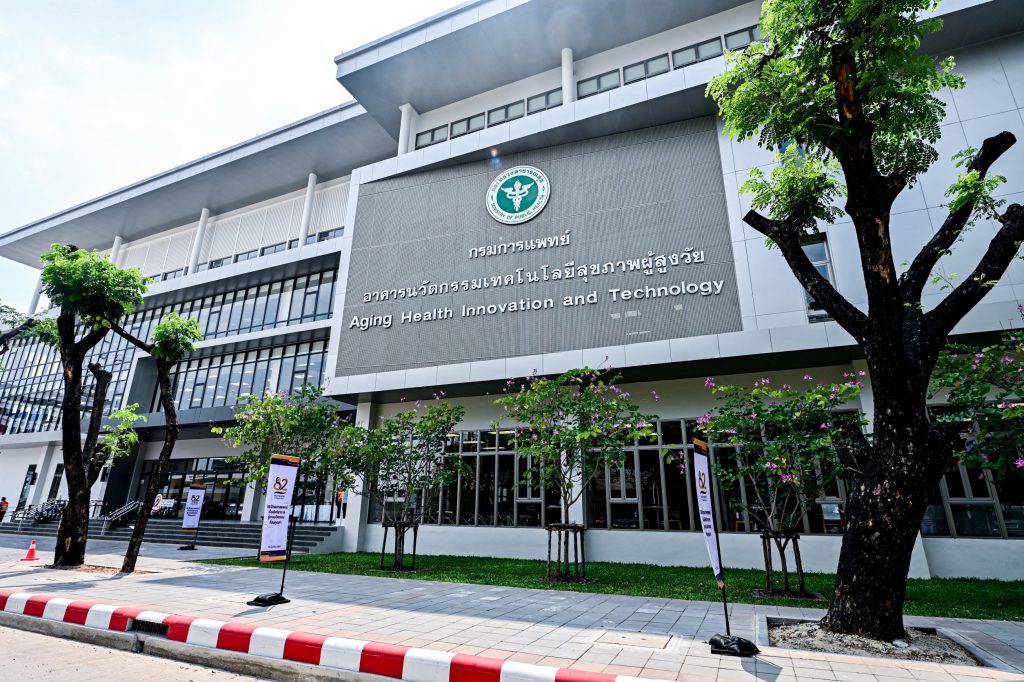
On 28 February 2024, the Institute of Geriatric Medicine for the Elderly relocated its headquarters to the Innovation and Technology Building for Healthy Aging, located on Public Health Soi 8. The facility offers comprehensive care services for older adults. It offers a variety of programs to promote physical, cognitive, and emotional well-being of the older adults, such as Day Service activities, aquatic therapy, Smart Gym sessions, physical and occupational therapy, geriatric clinics, and mental health clinics. In addition to its care services, the institute functions as a health and information center for the elderly, a hub for research and knowledge dissemination, and the official office of the ASEAN Center for Active Ageing and Innovation.